
How Many Habits Should You Track at Once? A Practical Guide
Tenor
Tenor Editorial Team
There is no scientifically proven number of habits that everyone should track.
But there is a useful starting point:
For most beginners, 1–3 meaningful habits is a sensible place to start.
That is not a biological limit or a magic formula. It is a practical way to reduce complexity while you learn what fits your life.
You may eventually track five habits, ten habits, or more. The right number depends on the difficulty, frequency, and importance of the behaviors — not simply the number of rows in your habit tracker.
The real goal is not to track as many habits as possible.
It is to consistently track the habits that matter.

Why There Is No Perfect Number of Habits
You will find productivity advice claiming that you should track exactly three habits, five habits, or seven habits.
Those numbers can be useful rules of thumb, but they should not be confused with a universal scientific prescription.
Habit formation is highly variable.
The amount of time required for a behavior to become more automatic differs between people and behaviors. Lally and colleagues' frequently cited research found substantial variation in the development of automaticity, rather than a single fixed timeline.
The same logic applies to habit count.
Two people might both track four habits but experience completely different levels of difficulty.
Consider:
Person A
- Take medication
- Drink water after waking
- Read five pages
- Stretch for two minutes
Person B
- Run for one hour
- Study for two hours
- Meditate for 45 minutes
- Cook every meal
Both are tracking four habits.
But their habit load is completely different.
So instead of asking only:
"How many habits should I track?"
ask:
"How much effort does my entire habit system require?"
A Good Starting Point: 1–3 Habits
If you are new to habit tracking, starting with one to three behaviors gives you enough structure without turning your tracker into another project.
For example:
Option 1: Health
- Walk for 20 minutes
- Stretch for five minutes
Option 2: Learning
- Read 10 pages
- Practice coding for 30 minutes
Option 3: Daily routine
- Plan tomorrow before bed
- Journal for five minutes
- Get ready for bed at a consistent time
Notice that these are specific behaviors.
Compare:
"Get healthier."
with:
"Walk for 20 minutes."
The second is much easier to evaluate.
The Problem With Starting With 10 Habits
A common pattern looks like this:
You get motivated.
You install a habit tracker.
Then you create:
- Wake up early
- Exercise
- Meditate
- Read
- Journal
- Study
- Drink more water
- Learn a language
- Avoid social media
- Sleep earlier
On paper, it looks ambitious.
In reality, you have created ten separate behaviors to remember, perform, and evaluate.
And many of them compete for the same resources.
Time.
Attention.
Energy.
The problem is not necessarily that you lack discipline.
The system may simply have too much behavioral overhead.
A habit tracker should make your routine easier to understand, not turn your entire day into a checklist.

Track Habit Load, Not Just Habit Count
Habit count is only one part of the equation.
When deciding whether to add another habit, look at four things.
1. Frequency
How often does it need to happen?
A weekly habit and a habit that needs to happen three times per day create different demands.
2. Duration
How long does it take?
"Read five pages" and "study for two hours" are both single habits, but they require very different amounts of time.
3. Difficulty
How much effort does the behavior require?
A behavior that takes almost no preparation is easier to fit into an unpredictable day.
4. Friction
How many steps are required before you can actually do it?
Going for a walk may require almost no preparation.
Going to the gym may involve changing clothes, travelling, completing a workout, showering, and getting home.
That does not make the gym habit bad.
It simply means the habit has a higher practical load.
One Habit Can Be a Complete Habit-Tracking System
You do not need a long list for habit tracking to be valuable.
Suppose you choose:
Walk for 20 minutes after dinner.
For the next few weeks, you can learn:
- Does after-dinner work well?
- What happens on busy days?
- What prevents you from doing it?
- Does the weather change your routine?
- Would a shorter version work?
- Does the behavior become easier when you repeat it in the same context?
That feedback can be more useful than adding nine more habits immediately.
A habit tracker is not just a record of completed boxes.
It can become a way to learn how your own routines behave.

Choose Habits That Support Your Bigger Goal
Another useful way to reduce overload is to work backward from your priorities.
Suppose your main goal is to improve your health.
You could create ten related habits.
But you probably do not need all ten.
Choose the behaviors with the strongest connection to your actual goal.
For example:
Goal: become more active
Possible habit:
Walk for 20 minutes after dinner.
Goal: improve reading consistency
Possible habit:
Read 10 pages before bed.
Goal: make studying more consistent
Possible habit:
Study for 30 minutes after breakfast.
A good habit is not merely something that sounds productive.
It should have a reason for existing.
Make the Minimum Version Small
One of the easiest ways to make a habit system more sustainable is to define a realistic minimum.
Instead of:
Exercise for one hour
your minimum could be:
Move for 10 minutes
Instead of:
Read 30 pages
your minimum could be:
Read five pages
Instead of:
Write 1,000 words
your minimum could be:
Write 100 words
The purpose is not to make your goals permanently tiny.
The purpose is to reduce the barrier to starting.
Once you begin, you can always continue longer.
This also makes the habit easier to maintain on difficult days.
Build Around Existing Routines
A new behavior is often easier to remember when it has a stable context.
For example:
- After brushing your teeth → floss
- After making coffee → read
- After lunch → take a walk
- Before bed → journal
This general idea is often called habit stacking.
The evidence specifically supporting the popular "habit stacking" method is still limited, but the underlying logic — using stable cues and repeating a specific behavior in a consistent context — is consistent with established approaches to habit formation. Recent expert reporting also cautions against treating habit stacking itself as a magic, universally proven technique.
The practical lesson is simple:
Make the behavior easier to remember by giving it a clear place in your existing day.
Don't Add Habits Just Because You Are Having a Good Week
This is one of the easiest traps to fall into.
Imagine you successfully maintain two habits for a week.
You feel great.
So you add three more.
Then your schedule gets busy.
Now you have five behaviors competing for attention.
A better approach is to treat adding a new habit as a deliberate decision, rather than a reward for temporary motivation.
Before adding another habit, ask:
- Are my current habits still manageable?
- Am I tracking them consistently?
- Do they still matter?
- Is the new habit more important than simplifying an existing one?
More is not automatically better.
What If You Want to Track More Than Three?
You can.
Once you understand what your schedule can handle, adding more habits may be completely reasonable.
The key is to watch for signs of habit overload.
For example:
- You frequently leave multiple habits incomplete.
- You feel stressed when you open your tracker.
- You track behaviors you no longer care about.
- You spend more time maintaining the tracker than doing the behaviors.
- You repeatedly reset the same habits.
- You are adding habits faster than you can stabilize existing ones.
That is usually a signal to simplify.
Interestingly, guidance from habit-tracking practitioners often emphasizes keeping the tracker focused on the most important behaviors rather than trying to record everything. James Clear, for example, recommends limiting tracking to a small number of important habits because tracking itself becomes an additional behavior to maintain.
A Simple Way to Choose Your First Three Habits
Try this exercise.
Step 1: Pick one important area
Choose one:
- Health
- Fitness
- Learning
- Work
- Personal routine
- Sleep
- Creativity
Step 2: Identify one behavior
Turn the goal into an action.
Not:
"Get fit."
Instead:
"Walk for 20 minutes."
Not:
"Learn Spanish."
Instead:
"Practice Spanish for 15 minutes."
Step 3: Add one supporting behavior
Choose a second habit that makes the first easier or supports the same goal.
For example:
Goal: exercise consistently
- Walk for 20 minutes
- Prepare workout clothes the night before
Step 4: Add a third only if necessary
You might stop at two.
That's fine.
Three is not a target you have to hit.
What About Different Frequencies?
Not every habit needs to be daily.
This is an important point because "daily habit tracker" searches can create the impression that every habit should be completed every day.
That's not true.
Some habits make more sense several times a week.
For example:
- Strength training — 3 times per week
- Long run — once per week
- Language practice — 5 times per week
- Meal preparation — once per week
- Room cleaning — once per week
The correct frequency depends on the behavior and your goal.
A habit tracker should reflect the behavior you actually want, rather than forcing everything into a daily schedule.
What If You Miss a Day?
Do not automatically interpret a missed day as a failed habit.
Instead, ask what happened.
Maybe the target was too ambitious.
Maybe your schedule changed.
Maybe the cue was unclear.
Maybe you need a smaller minimum.
A habit tracker becomes more useful when it helps you identify patterns instead of simply judging completion.
The aim is not a perfect calendar.
It is a sustainable behavior pattern.
How Do You Know When to Add Another Habit?
There is no universal waiting period.
Instead, look for evidence that your current system is stable enough to handle more complexity.
You may be ready when:
- Your existing habits feel relatively easy to remember.
- You are not constantly negotiating whether to do them.
- Your tracker is not creating stress.
- You understand when and where the behaviors fit.
- You can maintain them during ordinary busy weeks, not just ideal weeks.
Then consider adding one new behavior.
Not five.
Adding one at a time also makes it easier to understand what is helping and what is creating friction.
What Should You Do If Your Habit Tracker Feels Overwhelming?
Simplify before you abandon it.
Try this:
Keep: habits that matter and are manageable.
Shrink: habits that matter but are too difficult.
Pause: habits that are currently low priority.
You can always bring a paused habit back later.
There is no rule saying your final habit list has to look the same as your first one.
Your tracker should adapt to your life.
Frequently Asked Questions
How many habits should a beginner track?
A practical starting point is 1–3 habits. There is no scientifically established ideal number, but starting small reduces the amount of behavior you need to remember and makes it easier to learn what fits your routine.
Is 5 habits too many to track?
Not necessarily. Five simple habits may be easier to maintain than two demanding ones. Consider the total time, effort, frequency, and friction involved rather than the number alone.
Is it better to focus on one habit at a time?
For some people, yes. One habit can be a useful starting point because it keeps attention focused and makes it easier to understand what is helping or getting in the way.
Should I track habits every day?
Only when the behavior itself makes sense to repeat daily. Some habits are better tracked several times a week or weekly.
Should I track everything I want to improve?
Probably not. A tracker becomes less useful when it contains behaviors that you do not actually care about or cannot realistically maintain.
When should I add a new habit?
Add one when your current habit system feels manageable enough that another behavior will not make it unnecessarily complicated.
What if I keep failing the same habit?
Look at the behavior rather than blaming yourself. Reduce its minimum, change the cue or timing, or reconsider whether it is currently important enough to track.
The Bottom Line
There is no magic number of habits that everyone should track.
But starting with 1–3 meaningful habits is a practical way to build a manageable system.
From there, let your actual experience decide.
Track habits that matter.
Make them specific.
Keep the minimum realistic.
Use existing routines as cues.
Pay attention to patterns.
And add new behaviors only when your current system can comfortably support them.
The goal of a habit tracker is not to create the longest possible list.
It is to make the behaviors that matter easier to see, repeat, and improve.
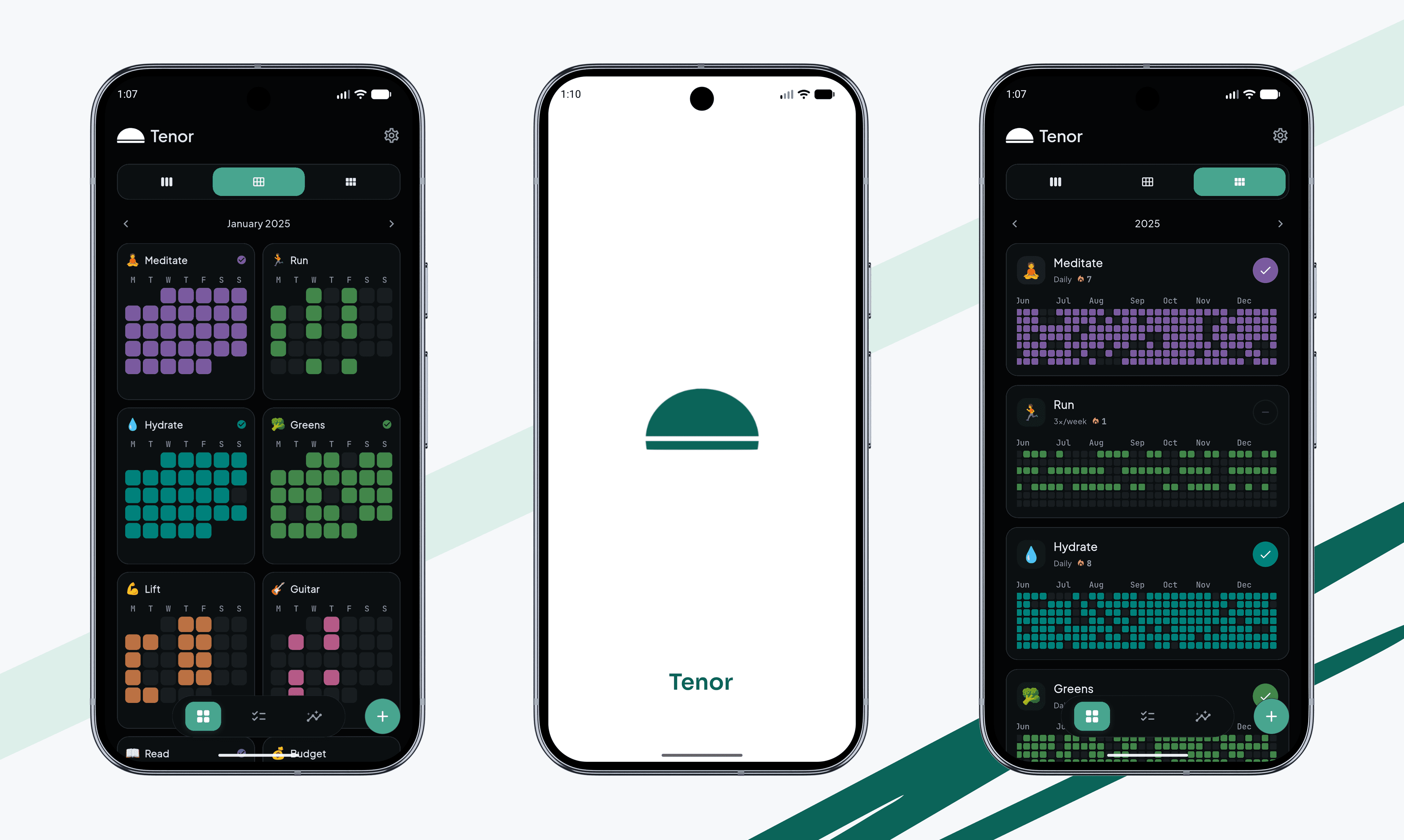
A focused habit tracker such as Tenor is useful for exactly that kind of system: keeping recurring behaviors visible without requiring you to turn every part of your life into a productivity project.

Related Reading
If you are deciding where each behavior belongs, read habit tracker vs to-do list: what's the difference. For a comparison of the best Android apps of 2026, see our guide to best habit tracker apps for Android. And if you want to understand why so many habit apps fall short, read why most habit trackers fail.
Enjoyed this? Share it with a friend.
Share on X