
Habit Stacking: What It Is, How It Works, and 25 Examples
Tenor
Tenor Editorial Team
A habit stack is a simple way to make a new behavior easier to remember by attaching it to something you already do consistently.
Instead of telling yourself, “I need to remember to meditate today,” you create a specific connection:
After I make my morning coffee, I will meditate for two minutes.
The coffee becomes the anchor. The meditation becomes the new habit.
The idea is simple, but good habit stacking is more than putting several activities into one morning routine. The anchor needs to be reliable, the new behavior needs to be specific, and the entire sequence needs to be realistic enough to repeat.
That is what makes habit stacking useful.

What Is Habit Stacking?
Habit stacking is a behavior-change technique in which you connect a behavior you want to develop to an existing behavior that already happens reliably.
The basic structure is:
After I [existing habit], I will [new habit].
For example:
After I brush my teeth, I will floss.
After I make coffee, I will read one page.
After I sit at my desk, I will write for five minutes.
After I finish lunch, I will take a short walk.
After I put my phone on charge, I will prepare tomorrow's clothes.
The existing behavior acts as a cue for the new behavior.
The term “habit stacking” was popularized by James Clear, while the broader behavioral principle of connecting actions to specific situational cues has a much longer history in behavioral science.
The Habit Stacking Formula
The easiest way to create a habit stack is:
After [existing habit], I will [new behavior].
For example:
After I brush my teeth at night, I will read five pages.
This is better than:
“I will read more.”
Why?
Because “read more” describes an intention.
The habit stack specifies when the behavior should happen and what action you will take.
This is closely related to the behavioral-science concept of an implementation intention: an if-then plan that connects a particular situation with a planned response. Research on implementation intentions has examined how specifying when and where an action will happen can help translate goals into behavior.
How to Build a Habit Stack
Creating a useful habit stack takes only a few steps.
1. Choose one habit you already do reliably
Start by listing behaviors that happen consistently.
Examples:
Wake up
Brush your teeth
Make coffee
Eat breakfast
Take a shower
Sit at your desk
Finish lunch
Come home from work
Put your phone on charge
Get into bed
The best anchor is not necessarily the most important activity in your day.
It is the one that happens reliably enough to remind you of the new behavior.
The Washington Post's 2026 expert guidance makes the same distinction: an anchor that varies significantly from day to day is less useful because the cue itself is unreliable.
2. Choose one small new behavior
Do not begin with:
“After coffee, I will completely transform my life.”
Choose something concrete.
Instead of:
“Exercise more.”
try:
“Do five squats.”
Instead of:
“Learn Spanish.”
try:
“Review five vocabulary words.”
Instead of:
“Read more.”
try:
“Read two pages.”
The smaller behavior gives you a realistic starting point.
3. Connect the two
Now write the stack as a sentence:
After I make coffee, I will read two pages.
Or:
After I finish lunch, I will walk for ten minutes.
The more specific the connection, the easier it is to understand what should happen next.
4. Repeat the same sequence
The goal is not to create a clever sentence.
The goal is repetition.
If you keep changing the anchor, time, location, and behavior, the association becomes harder to establish.
Research on habit formation has found that repeating a behavior in a consistent context is associated with increasing automaticity, although the rate varies considerably between individuals and behaviors.
5. Add another habit only after the first is stable
This is where many habit stacks go wrong.
Someone starts with:
Brush teeth → floss → meditate → stretch → journal → read → plan tomorrow.
It looks impressive.
It is also a lot to maintain.
A better approach is:
Brush teeth → floss
Then, once that sequence is reliable:
Brush teeth → floss → two-minute stretch
Build the chain gradually.

25 Habit Stacking Examples
The best habit stack depends on your existing routine, but these examples can help you design your own.
Morning Habit Stacking Examples
- Coffee + reading
After I make my morning coffee, I will read two pages.
A good option if coffee is already a reliable part of your morning.
- Brushing + flossing
After I brush my teeth, I will floss.
This is a classic example because the anchor and new behavior happen in the same location.
- Shower + stretching
After I finish my shower, I will stretch for two minutes.
- Getting dressed + planning
After I get dressed, I will check my calendar and choose my most important task.
- Breakfast + water
After I sit down for breakfast, I will drink a glass of water.
Work and Study Habit Stacks
- Opening your laptop + starting work
After I open my laptop, I will work on my highest-priority task for five minutes before checking social media.
- Sitting at your desk + writing
After I sit at my desk, I will write one paragraph.
- Starting a study session + phone away
After I open my textbook, I will put my phone out of reach.
- Finishing a work block + movement
After I finish a focused work session, I will stand up and walk for two minutes.
- Closing your laptop + planning tomorrow
After I finish work, I will write down tomorrow's first task.
Fitness Habit Stacks
- Changing clothes + movement
After I change into workout clothes, I will do five minutes of movement.
The first behavior reduces the friction of starting the second.
- Walking the dog + extra walking
After I finish my normal dog walk, I will walk for another five minutes.
- Watching TV + stretching
After I start watching my evening show, I will stretch for five minutes.
- Lunch + walking
After lunch, I will walk around the block.
- Brushing teeth + mobility
After brushing my teeth at night, I will do two minutes of mobility work.
Evening Habit Stacks
- Phone charging + preparation
After I put my phone on charge, I will prepare my clothes for tomorrow.
- Skincare + reading
After I finish my skincare routine, I will read five pages.
- Getting into bed + journaling
After I get into bed, I will write one sentence about the day.
- Dinner cleanup + planning
After I finish cleaning the kitchen, I will check tomorrow's schedule.
- Alarm setting + phone away
After I set my alarm, I will put my phone somewhere away from the bed.

Learning and Personal Development
- Morning coffee + language practice
After I make coffee, I will review five vocabulary words.
- Lunch break + reading
After I finish eating lunch, I will read for ten minutes.
- Opening your computer + writing
After I open my computer, I will write for five minutes before opening social media.
- Commute + audiobook
After I start my commute, I will listen to my audiobook.
- Weekly planning + habit review
After I finish planning my week, I will review my habit tracker.
What Makes a Good Habit Stack?
Not every combination is useful.
A good stack generally has three characteristics.
The anchor is reliable
If the anchor happens randomly, the new habit has no reliable trigger.
Compare:
Weak:
When I have free time, I will read.
“Free time” is unpredictable.
Stronger:
After I make coffee, I will read two pages.
Coffee is a much more concrete event.
The new behavior is specific
Avoid vague goals.
Weak:
After breakfast, I will exercise more.
Better:
After breakfast, I will do ten squats.
The second version tells you exactly what to do.
The new behavior is small enough to start
If the behavior requires a huge amount of preparation, the anchor may not be enough to make it happen.
For example:
After I brush my teeth, I will run 10 kilometers.
That is technically a stack.
It is not necessarily a good one.
A smaller version might be:
After I brush my teeth, I will put on my running shoes.
You can then build the behavior from there.
Why Habit Stacking Can Help
The strongest explanation is not that habit stacking somehow “rewires your brain instantly.”
The more defensible explanation is that an established behavior can provide a consistent cue for a new behavior.
Implementation-intention research supports the broader idea of connecting a specific situation with a planned response, while habit-formation research supports the importance of repetition in consistent contexts.
Habit stacking can therefore help with one of the basic problems of behavior change:
remembering to act.
You do not need to ask yourself:
“When should I do this?”
every day.
The existing routine provides the prompt.
That does not eliminate effort.
It simply makes the desired action more predictable.
Is Habit Stacking Actually Scientifically Proven?
This is where many articles overstate the evidence.
The general principles behind habit stacking have substantial behavioral-science support, but direct research specifically testing “habit stacking” as a branded technique is much more limited.
The Washington Post reported in April 2026 that behavioral scientist Katy Milkman described the direct evidence base as limited. It noted a small study involving 50 participants in which flossing after brushing was associated with stronger habit formation and more frequent flossing, while also emphasizing that there are not currently large, well-designed studies establishing habit stacking itself as a universally effective intervention.
That does not mean the technique is useless.
It means the accurate claim is:
Habit stacking is a practical application of principles involving cues, repetition, specificity, and context.
It should not be presented as a guaranteed psychological hack.
Habit Stacking vs. Habit Tracking
These two concepts are related but different.
Habit stacking tells you when to perform a behavior.
Habit tracking tells you whether you actually performed it.
For example:
Stack:
After I make coffee, I will read two pages.
Tracker:
Did I read two pages today?
The stack creates the behavioral cue.
The tracker gives you a record of consistency.
Using both can create a simple feedback loop:
Existing routine → new behavior → record completion → review pattern
This is one reason habit stacking and habit tracking work naturally together.
A habit tracker can also reveal whether your chosen anchor is actually useful.
If you repeatedly miss a habit after the same anchor, the problem may not be your motivation.
The anchor might simply be unreliable.
How to Track a Habit Stack
You do not need to track every part of a routine separately.
Start by tracking the new behavior you are trying to establish.
For example:
Anchor: After brushing my teeth New behavior: Read five pages
Track:
Reading — ✓ / missed
You can later review whether the behavior is becoming more consistent.
For more complicated routines, you can track individual behaviors:
| Habit | Mon | Tue | Wed | Thu | Fri |
|---|---|---|---|---|---|
| Floss | ✓ | ✓ | — | ✓ | ✓ |
| Stretch | ✓ | — | ✓ | ✓ | — |
| Read | ✓ | ✓ | ✓ | — | ✓ |
The objective is not to create the most complicated tracking system.
It is to make the behavior visible.

Common Habit Stacking Mistakes
- Stacking too many habits
Adding six new behaviors to one existing routine can turn a simple cue into an intimidating checklist.
Start with one.
- Choosing an unreliable anchor
“After I have free time” is not a reliable trigger.
Choose something that happens predictably.
- Making the new habit too large
A 60-minute workout is difficult to attach to a tiny routine if you are not already exercising regularly.
Start with a manageable behavior.
- Changing the stack constantly
If you move the habit from morning to afternoon to evening every few days, you lose some of the consistency that makes the cue useful.
- Treating a missed day as failure
Missing once does not tell you that the entire system is useless.
Look at the pattern.
- Using motivation as the anchor
“After I feel motivated, I will exercise” is not a cue.
Motivation fluctuates.
A stable behavior or event is a better anchor.
- Tracking too much
Remember that tracking is itself another behavior. James Clear makes this point in his habit-tracking guidance: consistent tracking of a small number of important habits can be more useful than trying to record everything.
What If Habit Stacking Doesn't Work?
First, diagnose the stack.
Ask:
Is the anchor reliable?
If not, choose another one.
Is the new habit too difficult?
Make it smaller.
Is the sequence inconvenient?
Change the location or timing.
Are you trying to add too much?
Remove the extra habits.
Is there too much friction?
Prepare what you need beforehand.
For example, if you want to exercise after waking but repeatedly fail because your workout clothes are somewhere else, prepare them the night before.
Sometimes the best improvement is not another motivational technique.
It is removing one obstacle.
If habit stacking still doesn't work, another behavioral approach may be more appropriate. Cleveland Clinic, for example, discusses shaping—gradually increasing a behavior toward a larger goal—as an alternative when stacking is not effective.
How Many Habits Should You Put in One Stack?
There is no universal maximum.
But if you are creating a new routine, start with one new behavior attached to one reliable anchor.
For example:
Brush teeth → floss
Once that feels natural:
Brush teeth → floss → stretch
Only add another step when the existing sequence is manageable.
This approach also aligns with current expert guidance recommending that people start with one small new habit and add another only after the first becomes relatively automatic.
For more guidance on choosing the number of habits to track, see How Many Habits Should You Track at Once?.
How Long Does Habit Stacking Take to Work?
There is no universal number of days.
The often-repeated “21 days” or “66 days” claims should not be treated as deadlines.
Lally and colleagues followed people practicing behaviors in consistent contexts over 12 weeks and found substantial variation in how quickly automaticity developed. The study does not support a single timetable that applies to everyone.
The more useful question is:
Is the behavior becoming easier and more automatic in its usual context?
If yes, the stack may be doing its job.
If not, change the design.
A Simple Habit-Stacking Template
You can create your own stack with this template:
Step 1: Existing habit
After I __________________________
Step 2: New behavior
I will __________________________
Step 3: Make it smaller
The minimum version is __________________________
Step 4: Define the location
I will do it at __________________________
Step 5: Track it
I will record whether I completed it.
For example:
After I make coffee, I will read two pages at my desk.
That's specific enough to act on and simple enough to test.

Frequently Asked Questions
What is habit stacking?
Habit stacking is a technique for connecting a new behavior to an existing, reliable behavior so the existing behavior can act as a cue for the new one.
What is the habit stacking formula?
The simplest formula is:
After I [existing habit], I will [new behavior].
For example: “After I brush my teeth, I will floss.”
Does habit stacking really work?
It can help, particularly when the existing behavior is reliable and the new behavior is specific and manageable. However, direct research specifically testing “habit stacking” is more limited than the broader research on cues, repetition, and implementation intentions.
What are some examples of habit stacking?
Examples include reading after making coffee, flossing after brushing your teeth, stretching after a shower, walking after lunch, or reviewing tomorrow's schedule after finishing work.
How many habits should I stack together?
Start with one new behavior. Once the sequence becomes manageable, you can consider adding another. Avoid creating a long chain simply because you can.
Is habit stacking the same as a routine?
Not exactly. A habit stack is a way of connecting behaviors using an existing cue. A routine can contain many behaviors and may or may not use explicit habit stacking.
What is the difference between habit stacking and habit tracking?
Habit stacking determines when a behavior should happen. Habit tracking records whether it happened.
Can I use a habit tracker for habit stacking?
Yes. You can use a habit tracker to record the new behavior in your stack and review whether the chosen cue is actually helping you stay consistent.
What should I do if I keep missing my habit stack?
Check the anchor, reduce the size of the new behavior, remove friction, or choose a different time and location. A missed habit is useful feedback about the design of the routine.
The Bottom Line
Habit stacking is not a magic shortcut for building habits.
It is a practical way to use something that already happens in your day as a cue for something you want to do more consistently.
Start with:
One reliable anchor.
One small behavior.
One clear connection.
Then repeat it.
If it works, keep it.
If it does not, change the design rather than simply blaming your motivation.
And once you have a few habits worth maintaining, use a habit tracker to see whether the behaviors are actually becoming consistent.
That combination—a reliable cue plus visible tracking—is far more useful than simply creating a long list of habits and hoping you remember to do them.
Track Your Stacks With Tenor
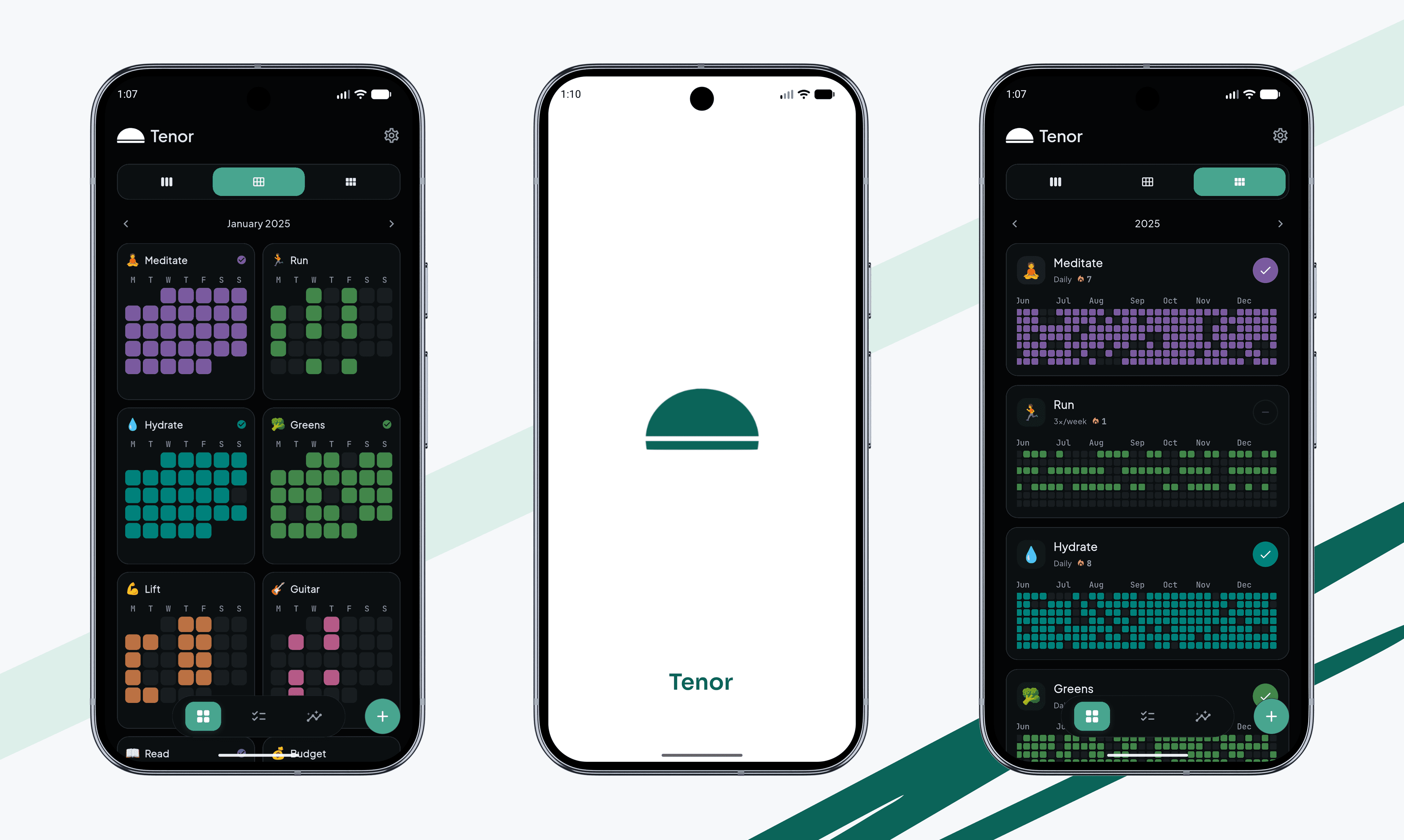
If you want a simple way to see whether your habit stacks are actually becoming consistent, Tenor gives you a clean space to track them.
Tenor lets you:
- Track individual habits in your stack with one-tap logging
- See your consistency over time with a visual calendar
- Use flexible scheduling so each habit matches your real routine
- Keep your history private without requiring an account

Enjoyed this? Share it with a friend.
Share on X